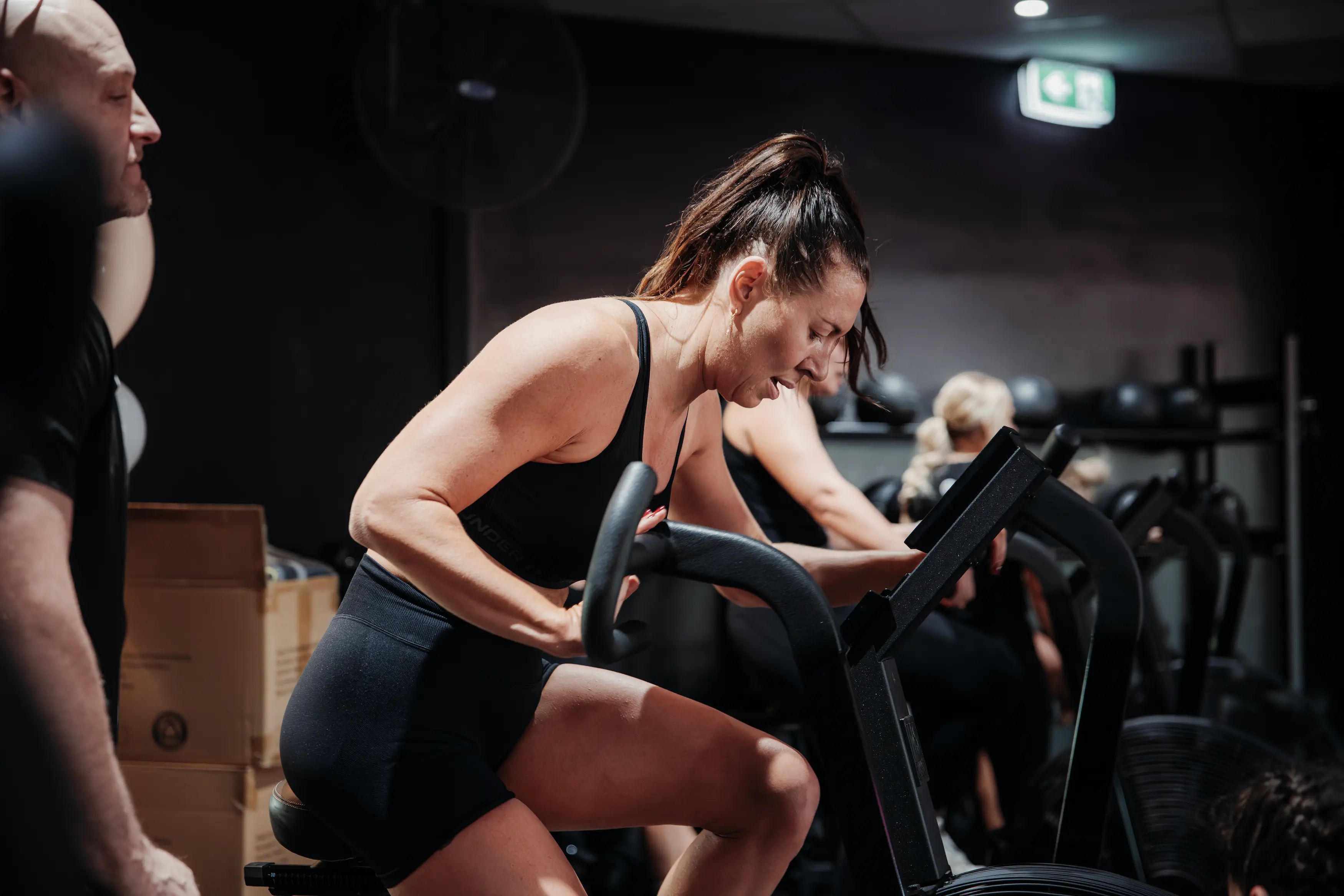
24%20(1).webp)
There's a version of getting fit that most of us have tried at least once: the solo plan. A program downloaded onto a phone, a pair of headphones, a promise to yourself that this time will be different. It often starts strong and it often quietly stops, not because the plan was wrong, but because willpower was never designed to carry a habit on its own for very long.
The people who keep training, year after year, tend to have something in common. It's not a better program or more discipline. It's other people.
You show up more when someone's expecting you
The simplest reason training with others works is the least glamorous: accountability. When a session is just you and an alarm, skipping it costs nothing but a quiet sense of guilt. When a session involves a friend, a coach, or a class full of familiar faces, skipping it costs something social and that small shift in cost changes behaviour more reliably than motivation ever does.
Researchers at Kansas State University tracked this directly, following exercisers who trained with a partner against those who trained alone. The partnered group didn't just enjoy their workouts more - they missed fewer of them, over a longer stretch of time, than people relying on self-motivation by itself.
You push harder next to someone else
There's a well-documented effect in exercise psychology sometimes called the Köhler effect: people working in a pair or small group, particularly alongside someone slightly fitter or stronger than themselves, will consistently outperform their own solo best. It isn't about competition in the aggressive sense. It's that effort becomes visible. A rep that would quietly get shortened when no one's watching gets completed properly when someone else is counting alongside you.
This is a big part of why group classes so often produce better session-to-session intensity than solo training, even for people who are technically capable of pushing themselves hard alone. Most people underestimate their own ceiling when there's no one there to show them where it actually is.
It feels like less effort, even when it's more
Ask anyone who's finished a hard group session what it felt like partway through, and the answer is rarely "unbearable." It's usually closer to "I didn't notice how hard that was until it was over." Training alongside others has a measurable effect on perceived exertion - the same effort simply feels lighter when it's shared, distracted by conversation, or carried along by the energy of a room.
Some of this comes down to physiology as much as psychology. Research into synchronised movement - groups rowing, running, or exercising in time with one another - has found it can raise pain tolerance and trigger a stronger endorphin response than the same effort performed solo. Moving in a group doesn't just distract from discomfort; it appears to change the body's own response to it.
The habit outlives the motivation
Motivation is unreliable by nature. It shows up strong in January and can quietly disappear by June.. What tends to survive the gap left behind is belonging - the sense that a particular time, a particular room, and a particular group of people are expecting you, regardless of how motivated you happen to feel that day.
This is the real long game of social fitness. It's not that training with others makes any single session better, although it usually does. It's that it turns exercise from a decision you have to keep making into a routine you simply show up for, the same way you'd show up for a standing arrangement with a friend.
Bringing it into your own training
None of this is an argument against solo training. There's real value in time spent working through a session on your own terms. But if consistency has been the harder part of the equation, the fix is rarely a better plan. It's more often a better room to be in it with.
That's the thinking behind the group side of what happens at FIT: classes built around shared effort, a community that notices when a familiar face is missing, and recovery spaces designed for slowing down together rather than alone. Training with others isn't a substitute for hard work. It's what makes hard work sustainable.